Skip to Main Content

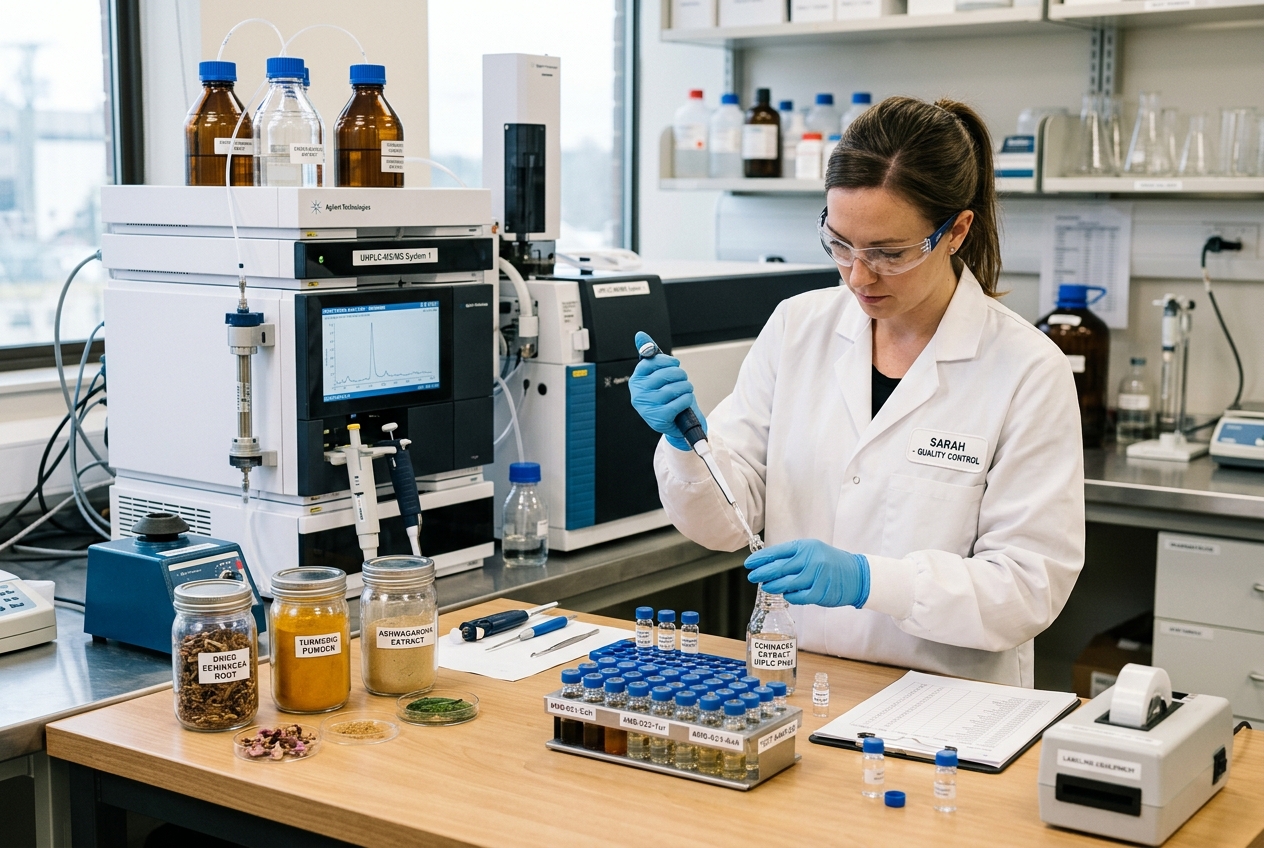
Natural health product and supplement testing helps manufacturers, importers, brand owners, ingredient suppliers and product developers evaluate microbiological quality, composition, raw materials, contaminants and finished products against defined specifications.

The right laboratory testing program depends on the product, matrix, ingredients, specification and decision the analytical results need to support.

PBR Laboratories provides laboratory testing support from Edmonton for natural health products, supplements and related ingredients across Alberta, Western Canada and Canada.

Our approach goes beyond generating analytical data. PBR helps clients understand the testing options relevant to their product and how laboratory results can support practical quality decisions.

What Natural Health Product Testing Can Help You Decide

Laboratory testing may be required at different points between incoming ingredients and finished-product release.

Testing can support decisions such as:

  • Should an incoming ingredient lot be accepted?
  • Does a product meet an established microbiological specification?
  • Is an unexpected microbial result significant?
  • Does the measured composition align with the intended specification?
  • Should botanical ingredients be investigated for mycotoxins?
  • Does a finished product meet defined release criteria?
  • What additional testing may be appropriate after an unexpected or out-of-specification result?

The analytical method and sampling plan should be selected around the decision being made. Results apply to the submitted sample, and sampling design affects how confidently those results can represent a larger lot or batch. This is a core principle in PBR's testing framework.

Natural Health Product & Supplement Testing Services

United States Pharmacopeia Testing

PBR provides selected testing using recognized United States Pharmacopeia methods for applicable natural health products, supplements, ingredients and related matrices.

PBR capabilities include testing associated with:

United States Pharmacopeia <61> — Microbial Enumeration Tests

Microbial enumeration testing can be used to evaluate the microbial population of applicable products against established specifications.

Testing may include:

  • total aerobic microbial count;
  • total yeast and mould count.

Results can support finished-product assessment, investigation and quality-control decisions.

United States Pharmacopeia <62> — Tests for Specified Microorganisms

Testing for specified microorganisms evaluates applicable products for microorganisms relevant to the product and established specification.

Depending on the matrix and testing objective, organisms may include:

  • Escherichia coli;
  • Salmonella species;
  • Staphylococcus aureus;
  • Pseudomonas aeruginosa;
  • other specified microorganisms where applicable.
United States Pharmacopeia <2021> — Microbial Enumeration Tests for Nutritional and Dietary Supplements

PBR provides applicable microbiological enumeration testing for supplement matrices using United States Pharmacopeia methodology.

This testing can support assessment of microbial quality against established specifications for applicable supplement products.

United States Pharmacopeia <2022> — Tests for Specified Microorganisms in Nutritional and Dietary Supplements

Specified-microorganism testing can support evaluation of applicable supplement products for relevant objectionable or specified microorganisms.

PBR's existing service catalogue documents a United States Pharmacopeia <2021>/<2022> microbiological service group covering yeast and mould, total aerobic plate count, bile-tolerant Gram-negative bacteria, Escherichia coli, Salmonella, Staphylococcus aureus and Pseudomonas aeruginosa.

United States Pharmacopeia <85> — Bacterial Endotoxins Test

PBR also provides bacterial endotoxin testing using the United States Pharmacopeia <85> Gel-Clot Assay for applicable matrices. This capability is specifically documented in PBR's service catalogue.

Bacterial endotoxin testing answers a different analytical question from viable microbial enumeration or specified-organism testing. The appropriate test depends on the product, matrix, intended use and applicable specification.

Ask PBR which United States Pharmacopeia testing approach is appropriate for your product and matrix.

Explore United States Pharmacopeia Testing →

Natural Health Product Microbiology Testing

Microbiological quality can be an important component of raw-material assessment, finished-product specifications, investigation and product-release programs.

Depending on the product, matrix and specification, PBR can discuss testing for:

  • total aerobic microbial count;
  • yeast and mould;
  • bile-tolerant Gram-negative bacteria;
  • Escherichia coli;
  • Salmonella species;
  • Staphylococcus aureus;
  • Pseudomonas aeruginosa.
What can microbiological results help determine?

Results may support:

Ingredient acceptance → Manufacturing investigation → Finished-product assessment → Product-release decisions → Corrective action

A microbiological result should be evaluated against the applicable product specification rather than interpreted in isolation.

Explore Natural Health Product Microbiology Testing →

Nutritional & Composition Analysis

PBR provides analytical capabilities that can support nutritional and compositional evaluation of applicable supplement, ingredient and finished-product matrices.

PBR's documented capabilities include:

  • calories;
  • carbohydrates;
  • protein;
  • dietary fibre;
  • sugars;
  • total fat;
  • fatty acids;
  • cholesterol;
  • calcium;
  • iron;
  • sodium;
  • potassium;
  • magnesium;
  • ash;
  • moisture.

PBR's service catalogue also identifies individual analytical capabilities for:

  • vitamin A;
  • vitamin C;
  • vitamin D.
What decisions can nutritional and composition testing support?

Results may support:

  • product development;
  • formulation verification;
  • ingredient evaluation;
  • product characterization;
  • quality specifications;
  • investigation of unexpected composition results.
Nutritional analysis and medicinal-ingredient testing are not automatically the same

The appropriate analysis depends on the product formulation, ingredient, specification and reason for testing.

A nutritional-composition panel should not automatically be considered equivalent to identity, quantity or potency testing of a medicinal ingredient.

Speak with PBR about your product and analytical objective before selecting a testing panel.

Explore Nutritional & Composition Analysis →

Ingredient & Raw Material Testing

Quality decisions can begin before a natural health product reaches manufacturing.

Testing raw materials and ingredients can provide analytical information supporting:

  • supplier qualification;
  • incoming lot acceptance;
  • ingredient characterization;
  • purchasing specifications;
  • contamination investigations;
  • comparison with supplier documentation.

Depending on the material and testing objective, relevant PBR capabilities may include:

Microbiology | Moisture | Water Activity | Nutritional & Composition Parameters | Mycotoxins | Selected Contaminant Testing

Sampling is particularly important for heterogeneous ingredients. A small submitted sample may not adequately represent a large lot unless the sampling plan is designed around the acceptance decision.

Explore Ingredient & Raw Material Testing →

Mycotoxin Testing for Natural Health Products

Botanical, agricultural and other plant-derived ingredients can present mycotoxin concerns depending on the material, growing conditions, storage and processing history.

PBR's documented capabilities include:

  • Aflatoxin B1;
  • Aflatoxin B2;
  • Aflatoxin G1;
  • Aflatoxin G2;
  • total aflatoxins;
  • Ochratoxin A.
When should mycotoxin testing be considered?

Testing may support:

  • supplier qualification;
  • incoming ingredient acceptance;
  • investigation of suspect materials;
  • comparison against established specifications;
  • finished-product investigations where relevant.
Why is sampling especially important for mycotoxins?

Mycotoxins can be unevenly distributed through botanical materials, grains, powders and other heterogeneous ingredients.

A laboratory result represents the submitted sample. Therefore, lot coverage and sample representativeness are important when the result will support an acceptance or rejection decision.

Explore Natural Health Product Mycotoxin Testing →

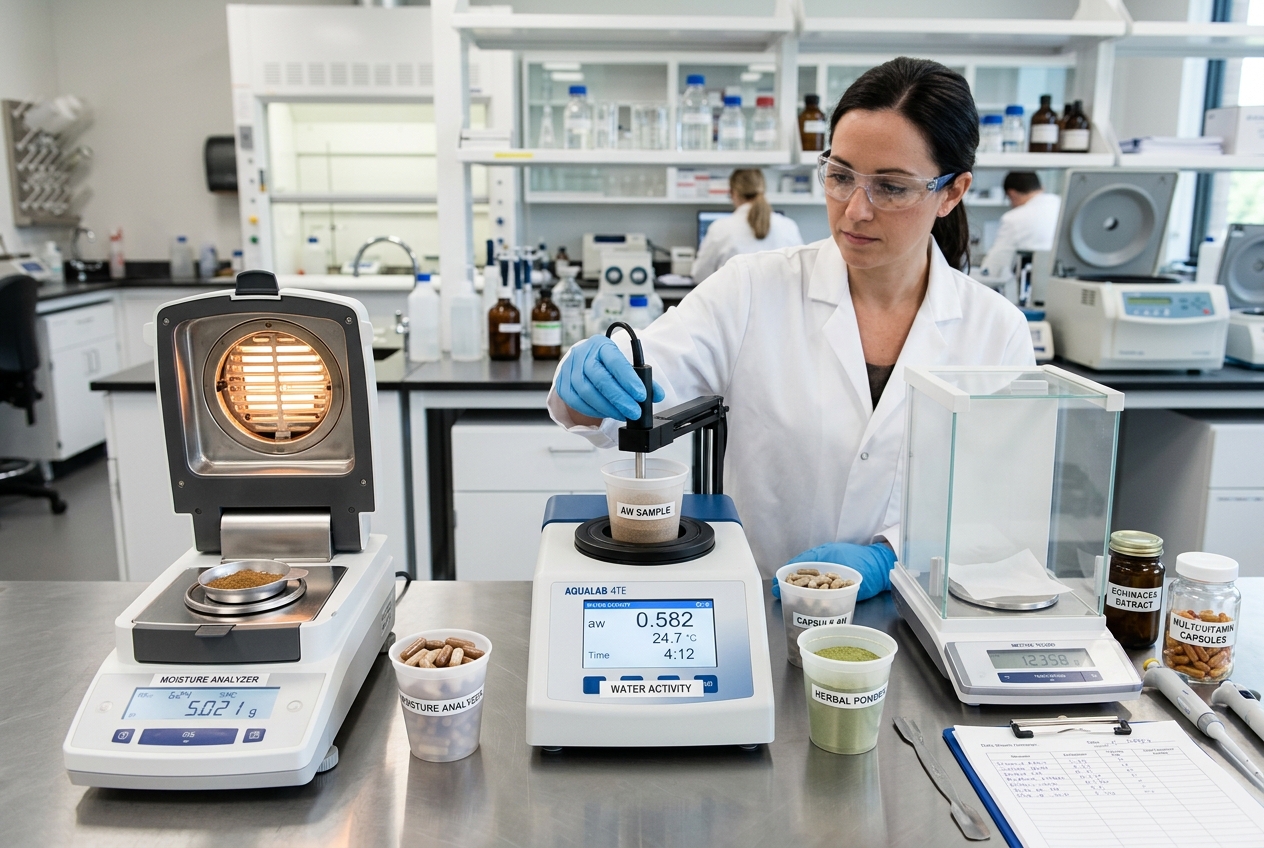
Moisture & Water Activity Testing

Moisture content and water activity provide different information about a natural health product or ingredient.

Testing can support investigations involving:

  • ingredient storage;
  • product stability;
  • susceptibility to microbial growth;
  • powder consistency;
  • formulation;
  • shelf-life behaviour.
What is the difference between moisture and water activity?

Moisture content measures the amount of water present in a product.

Water activity evaluates how available that water is to participate in microbial growth and other reactions.

Because they answer different questions, moisture and water activity should not automatically be treated as interchangeable measurements.

PBR's service catalogue documents both moisture and water activity capabilities.

Explore Moisture & Water Activity Testing →

Related Resource: Water Activity vs Moisture in Supplements →

Heavy Metals & Chemical Contaminant Testing

Natural health product manufacturers may need to consider elemental or chemical contaminants based on the ingredients, product and applicable specifications.

Potential elemental contaminants can include:

  • lead;
  • arsenic;
  • cadmium;
  • mercury.

PBR's existing service documentation identifies heavy-metal testing for certain matrices, with some analysis identified as subcontracted.

For that reason, the appropriate analytical capability should be confirmed for the specific natural health product or ingredient before samples are submitted.

Ask PBR about your matrix, target elements and required specification.

Explore Heavy Metals & Contaminant Testing →

Finished Product Testing

Finished-product testing connects analytical measurements with one of the most important quality questions:

Does this product meet its established specification?

Depending on the product and specification, finished-product testing may address:

  • microbiological quality;
  • specified microorganisms;
  • nutritional or compositional parameters;
  • moisture;
  • water activity;
  • mycotoxins;
  • selected contaminants;
  • other product-specific parameters.
What decisions can finished-product testing support?

Laboratory results may contribute to:

  • finished-product specification assessment;
  • batch-release decisions;
  • quality documentation;
  • investigation of unexpected results;
  • manufacturing follow-up;
  • corrective action.

Explore Natural Health Product Finished Product Testing →

What Happens When a Natural Health Product Fails Specification?

An unexpected or out-of-specification result does not automatically mean that simply repeating the same test is the appropriate next step.

The investigation may need to consider:

  • the applicable specification;
  • sample identity;
  • sample representativeness;
  • matrix suitability;
  • analytical method;
  • ingredient information;
  • supplier documentation;
  • manufacturing records;
  • previous results;
  • related analytical parameters.

The appropriate follow-up depends on the product, result, specification and quality system.

PBR can help clients understand the analytical result and discuss relevant testing options for the investigation.

Read: What Happens When a Natural Health Product Fails Specification? →

Testing by Product Type

Different natural health products present different analytical risks and testing questions.

Botanical & Herbal Products

Microbiology, mycotoxins, moisture and other ingredient-specific parameters may be relevant depending on the formulation and source materials.

Explore Botanical & Herbal Product Testing →

Powdered Supplements

Microbiology, moisture, water activity, composition and ingredient consistency can be important considerations for powdered products.

Explore Powdered Supplement Testing →

Vitamin & Mineral Products

Testing should be selected according to the formulation, product specification and analytical objective.

Explore Vitamin & Mineral Product Testing →

Protein & Sports Nutrition Products

Relevant analytical questions can include nutritional composition, microbiological quality, moisture and ingredient characteristics.

Explore Protein & Sports Nutrition Testing →

Capsules & Tablets

Testing programs should reflect the ingredients, dosage form, finished-product specification and quality decision.

Explore Capsule & Tablet Testing →

Liquid Supplements

Microbiological quality, composition and stability-related parameters may be relevant depending on the formulation and product specification.

Explore Liquid Supplement Testing →

Natural Health Product Testing in Alberta, Western Canada & Across Canada

PBR Laboratories provides analytical testing support from Edmonton for natural health product manufacturers, supplement companies, ingredient suppliers, importers and product developers.

Natural Health Product Testing in Alberta

PBR gives Alberta companies regional access to laboratory testing and technical communication about sample matrices, testing objectives and analytical requirements.

Natural Health Product Testing Across Western Canada

Manufacturers and suppliers throughout Western Canada can work with PBR to select testing appropriate to their products, ingredients and quality decisions.

Natural Health Product & Supplement Testing Across Canada

PBR supports Canadian companies seeking applicable United States Pharmacopeia microbiology, nutritional and composition analysis, ingredient testing, mycotoxin testing and related analytical services.

PBR helps clients understand laboratory results and make informed decisions—not simply receive analytical data.

Frequently Asked Questions

The appropriate testing depends on the product, ingredients, dosage form, specifications and quality risks. Testing may include microbiological enumeration, specified microorganisms, nutritional or compositional parameters, moisture, water activity, mycotoxins, contaminants and other product-specific analyses.

PBR provides selected testing using United States Pharmacopeia <61>, <62>, <2021>, <2022> and <85> for applicable matrices. These methods address different microbiological and endotoxin-testing objectives. Clients should discuss their product matrix, specification and testing objective with PBR to determine the appropriate method.

United States Pharmacopeia <61> addresses microbial enumeration, while United States Pharmacopeia <62> addresses tests for specified microorganisms. They answer different microbiological quality questions and may be used together depending on the product and specification.

United States Pharmacopeia <2021> addresses microbial enumeration for applicable nutritional and dietary supplement products, while <2022> addresses testing for specified microorganisms in applicable supplement matrices.

Yes. PBR's service catalogue documents United States Pharmacopeia <85> bacterial endotoxin testing using the Gel-Clot Assay. Clients should confirm matrix applicability and sample requirements with PBR before submission.

PBR's documented capabilities include protein, carbohydrates, dietary fibre, sugars, fats, fatty acids, selected minerals, ash, moisture and selected vitamins. The appropriate panel depends on the formulation and analytical objective.

Yes, for applicable matrices. PBR's documented capabilities include aflatoxins and Ochratoxin A. Because mycotoxins can be unevenly distributed, representative sampling is important when results will support lot-level decisions.

It depends on the analytical parameter, product specification and decision. Ingredient testing may support supplier and incoming-lot decisions, while finished-product testing can support assessment against finished-product specifications.

Review the result against the applicable specification and consider sample representativeness, matrix suitability, analytical method, ingredients, supplier information and manufacturing records before deciding on follow-up testing. The appropriate response depends on the product and quality system.

Yes. PBR is based in Edmonton and supports clients throughout Alberta, Western Canada and Canada. Contact PBR to confirm matrix suitability, sample requirements and available testing.


Need Natural Health Product or Supplement Testing?

Not every natural health product requires the same testing program.

Tell PBR:

what the product is → what matrix is being submitted → what specification applies → what analytical question needs to be answered.

PBR can then discuss relevant testing options, method applicability and sample requirements.

Choose PBR — Because Precision Matters, Defining Excellence in Laboratory Services Since 1984.