


Phone No.
(780) 450-3957
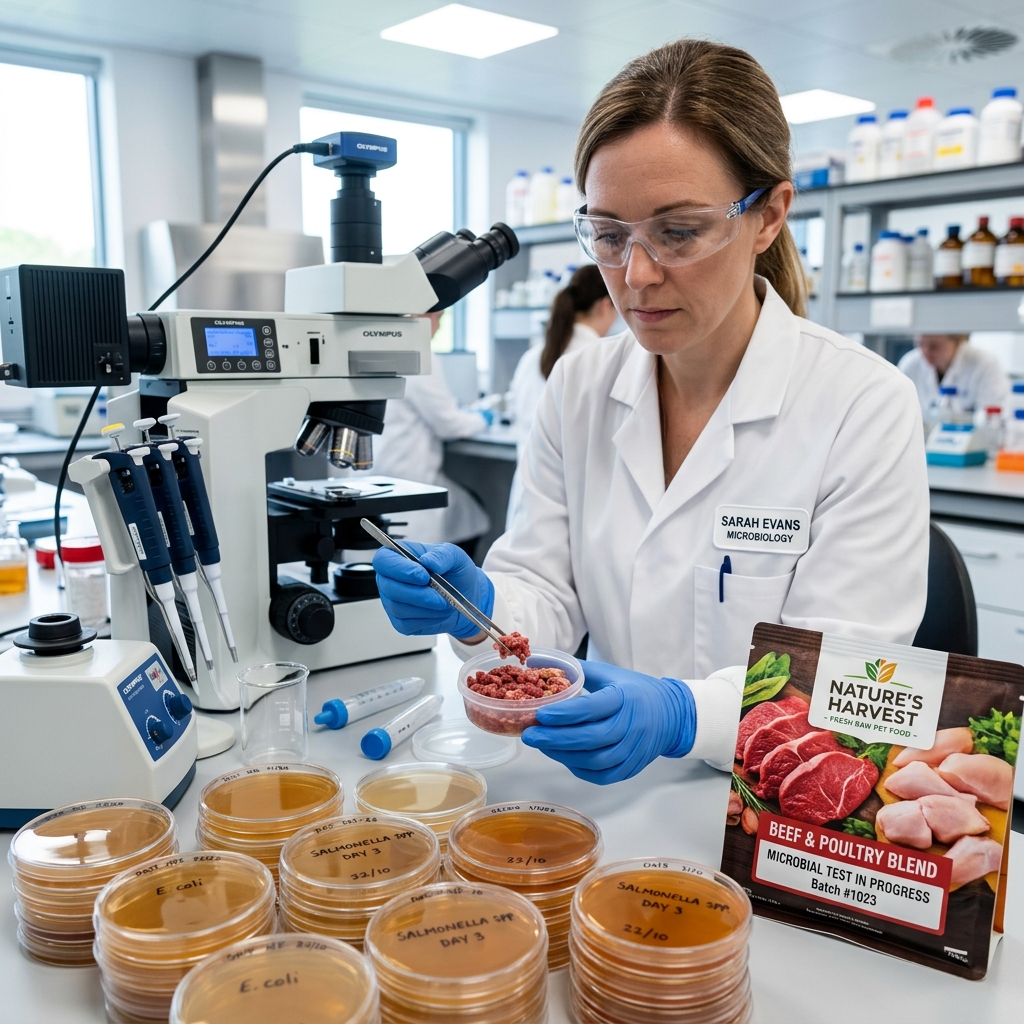
Raw pet food manufacturers face unique microbiological and quality challenges.
Because products often contain raw meat, poultry, organs, and other minimally processed ingredients, testing programs are frequently designed to support food safety verification, product quality objectives, and customer requirements.
PBR Laboratories provides food pathogen testing, food microbiology testing, nutritional analysis, ingredient testing, and shelf-life studies for raw pet food manufacturers throughout Alberta, Western Canada, and Canada.
Whether producing:
Testing helps manufacturers answer critical questions:
The objective is supporting product quality and informed decision-making.
Food pathogen testing is commonly incorporated into raw pet food verification programs.
Common testing includes:
One of the most frequently requested tests for raw pet food products. For result interpretation, see Understanding Salmonella Results.
Often included in risk-based food safety programs.
Frequently evaluated in products containing raw meat ingredients. See Understanding E. coli O157:H7 Results.
May be included alongside Escherichia coli (E. coli) O157:H7 testing.
Routine microbiology testing helps evaluate manufacturing consistency and product quality.
Common testing includes:
Provides information regarding overall microbial populations.
Supports sanitation and process control evaluations.
Used as an indicator organism.
Provides broader hygiene and process control information.
Supports shelf-life and product stability evaluations.
Nutritional analysis helps manufacturers verify formulation targets and product consistency.
Ingredient testing helps manufacturers evaluate:
Shelf-life studies help manufacturers evaluate:
Testing may include:
When pathogen or microbiology results indicate a concern:
Testing is most valuable when it supports informed decisions and continuous improvement.
Common testing may include Salmonella spp., Listeria monocytogenes, Escherichia coli (E. coli) O157:H7, and Non-O157 Shiga Toxin-Producing Escherichia coli (STEC) depending on product risks and testing objectives.
Microbiology testing helps evaluate product quality, process consistency, and manufacturing controls.
Nutritional testing helps verify formulation targets and support quality assurance programs.
Yes. Shelf-life studies help evaluate product stability, microbiological trends, and packaging performance.
Review ingredients, production records, testing trends, corrective actions, and conduct root cause investigations where appropriate.
PBR Laboratories provides food pathogen testing, food microbiology testing, nutritional analysis, ingredient testing, and shelf-life studies for raw pet food manufacturers throughout Alberta, Western Canada, and Canada.
Contact PBR to discuss pathogen testing programs, nutritional verification, shelf-life validation, supplier qualification, and product testing requirements.